|
 |
 |
 |
 |
 |
 |
 |
 |
 |
 |
 |
 |
 |
 |
 |
 |
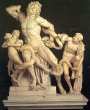 It's already well known that Michelangelo dabbled in art forgery. That's not disputed. For instance, there's his famous forgery of the Sleeping Cupid. However, Lynn Catterson of Columbia University thinks that a much more high-profile forgery should be attributed to him. She believes that Michelangelo forged The Laocoon, which has long been regarded as one of the most important pieces of ancient Greek sculpture in existence. She points out that Michelangelo was present when The Laocoon was unearthed in 1506. She has promised to provide further proof to back up her allegation at a lecture today, as well as in a book she's submitted for publication. (thanks to Jelena for the link)
 Some guy (I can't find his name) has put together a huge and fascinating collection of examples of 'adventure art'. Many of the examples he describes are basically elaborate pranks. Some of the stuff is completely insane. Many of the stunts seem to end with the artist's arrest. I haven't had the time to read all of it, but here are a few samples that caught my eye:
 In 2001 artist Gordon Young placed a block of sculpted granite in Carlisle's Tullie House Museum. The granite is inscribed with an ancient curse against local highwaymen and robbers. But some people in the city feel that ever since the 'cursing stone' was placed there, bad luck has plagued the city. "Livestock herds around the city on the border with Scotland were wiped out by foot-and-mouth disease, there has been a devastating flood, factories have closed, a boy was murdered in a local bakery and Carlisle United soccer team dropped a league." So now a local politician has introduced a bill to remove the Cursing Stone and have it destroyed, in the belief that this will bring good luck back to Carlisle. The suggestion has sparked quite a bit of controversy, as well as an angry response from the artist. Personally I think that if Carlisle wants to get rid of its bad luck it should stop fooling around with removing stones and go ahead and burn a witch. After all, that seemed to work for Salem. Didn't it?
 A series of scans has appeared on the scans_daily LiveJournal blog, apparently from an early Batman comic (Batman #66). It details a 'boner' made by the Joker, and his subsequent efforts to force Batman 'into a boner'. The word boner is repeated so often that it seems like it has to be a joke, especially when you read lines such as "Gotham City will rue the day it mentioned the word Boner!" Perhaps someone photoshopped the word 'boner' into an issue of Batman. But I don't think so. I think it's real, although I can't be sure since I don't have a copy of that particular Batman comic (in fact, I don't have any Batman comics). The cover of that issue can be seen here. It's titled 'The Joker's Comedy of Errors!' So the issue itself is real, and 'boner' can mean an error. I think that it's only in recent decades that boner has come to predominantly refer to something else.
 For almost twenty years Glaswegians have enthusiastically upheld a tradition of placing traffic cones on top of a statue of the Duke of Wellington that stands in the city center. You can even buy postcards and t-shirts displaying a cone-wearing Wellington. But now the fun might come to an end on account of art historian Gary Nisbet who claims that the cone prank threatens to seriously damage the 160-year-old statue. He's campaigning to get people who climb up on the statue charged with vandalism. Unfortunately this would make a number of the city councillors vandals. Nisbet's proposal doesn't seem to be going over well at all with the residents of Glasgow, most of whom seem to think the cone is the best thing about the statue.
 I received this email yesterday from an artist requesting my opinion. Feel free to leave your own opinion in the comments:
 Stan Murmur has a good thing going. He smears paint on his buttocks, smacks his fanny on a piece of paper, and sells the resulting product for hundreds of dollars. Is it really art? Well, no. It's Butt Art. I think this probably qualifies as something that started out as a bit of a joke, but then somehow turned into a real thing for him.
 Bill Dan balances rocks. His balanced rocks look very cool, but I have a hard time believing that they're all just balancing naturally without a little extra help. Actually, he seems quite legitimate... and they're supposed to look like they're defying gravity. That's the whole point. But still. Some of the rocks on his site I look at and say to myself 'there's no way that would possibly stand.' (via j-walk)
 Once upon a time a popular art hoax involved getting critics to praise a work of art, and then revealing that the work was really created by a monkey or a child, thereby proving what poor judgement the critics had. For instance, in the 1960s critics were embarrassed by the cases of Pierre Brassau, the monkey artist, as well as Willie the Painting Worm. But I don't think that kind of hoax would work today because critics seem to be voluntarily lining up to heap praise on works by animals and infants. Paintings by asian elephants are fetching thousands of dollars, and now a 4-year-old girl in New York, Marla Olmstead, is creating a buzz in the art world, having just had her own gallery show. That's one of her paintings to the right. The owner of the gallery said it was his most successful show ever. The NY Times reports that "Marla has sold 24 paintings totaling nearly $40,000, with the prices going up. Her latest paintings are selling for $6,000. Some customers are on a waiting list." I guess this proves that art is whatever critics say is art. It also proves that I'm definitely in the wrong line of work. Maybe I should branch out as the art manager for my 6-year-old niece, Astrid. She's done some very good work, if I may say so myself. For instance, her work shown below (titled: 'butterfly wings painted on a face') not only daringly uses her own face as a canvas, but also clearly evokes echoes of Picasso and Gauguin.

 A major new talent can be added to the rollcall of nonexistent artists: Naomi V. Jelish. Naomi is a 13-year-old prodigy. She has a collection of sketches currently on exhibit at the Saatchi Gallery in London. But Naomi doesn't actually exist. Naomi and her work are the fictional creation of 25-year-old artist Jamie Shovlin (Naomi V. Jelish is an anagram of Jamie Shovlin). Visitors to the exhibit are given no clue that Naomi is fictitious. Other nonexistent artists that I'm aware of are Johann Dieter Wassmann and Pavel Jerdanowitch. (thanks to hollydog in the Hoax Forum for the link)
 Once thought to be a fake Vermeer, this painting of a young woman sitting before a keyboard has now been officially reclassified as a real Vermeer. It's going up for sale (the first time a Vermeer has been sold since 1921), so if you've got a couple of million lying around, feel free to make a bid.